
The App Marketing Landscape Is More Competitive Than Ever, But Most Companies Are Using the Wrong Resources
Here is a number that should stop you cold: over 1.8 million apps are available on the Apple App Store alone, with Google Play hosting more than 2.6 million (Statista 2024). With that level of saturation, mobile app companies that rely on guesswork instead of proven, data-backed resources are burning budget and losing ground every single day. The gap between apps that scale and apps that stagnate almost always comes down to the quality of marketing resources being used, not the product itself.
This post breaks down exactly which app marketing resources actually move the needle in 2025. You will learn which tools, frameworks, benchmarks, and strategies top-performing mobile companies use to drive sustainable growth, and which so-called "resources" are simply noise dressed up in a nice dashboard. Whether you are pre-launch or scaling to your next million users, this guide gives you actionable direction.
Key Takeaways
- The average cost-per-install (CPI) across all categories sits at $1.72 for iOS and $0.44 for Android globally, making budget allocation strategy a critical resource in itself (AppsFlyer 2024).
- Apps that use deep linking and retargeting see 2x higher retention rates at day 30 compared to those relying solely on top-of-funnel acquisition (Adjust 2024).
- Only 32% of app marketers report using App Store Optimization (ASO) tools consistently, meaning the majority are leaving organic traffic on the table (Sensor Tower 2024).
- Mobile app marketing teams that leverage first-party data and in-app analytics are 3x more likely to hit their user acquisition targets quarter-over-quarter (AppsFlyer 2024).

What Are the Most Essential App Marketing Resources for Mobile Growth Teams?
The most essential app marketing resources fall into five clear categories: analytics platforms, ASO tools, paid acquisition frameworks, lifecycle messaging tools, and competitive intelligence databases. Without coverage across all five, your marketing efforts will have blind spots that quietly drain revenue.
Most mobile teams make the mistake of over-investing in one category, usually paid acquisition, while neglecting the others. Paid installs without lifecycle messaging leads to churn. Lifecycle messaging without solid analytics leads to sending the right message to the wrong person at the wrong time. The strongest growth teams treat their resource stack as an interconnected system, not a collection of isolated tools.
Start with analytics. AppsFlyer and Adjust are the two dominant mobile measurement partners (MMPs) used by enterprise and mid-market app companies in the US. Both provide attribution data, cohort analysis, and fraud prevention. AppsFlyer's 2024 research shows that apps using MMPs reduce wasted ad spend by an average of 37% compared to teams relying on platform-native reporting alone (AppsFlyer 2024). That number alone justifies the subscription cost for virtually any monetizing app.
For ASO, Sensor Tower and Mobile Action are the category leaders. Sensor Tower provides keyword ranking data, download estimates, and revenue intelligence across both major stores. Mobile Action layers in competitor tracking and AI-driven keyword suggestions. If you are choosing one, consider your primary use case: Sensor Tower excels in competitive market intelligence, while Mobile Action is stronger for keyword optimization workflows.
A real-world example: Duolingo, one of the most-downloaded education apps globally, has publicly credited disciplined ASO iteration as a core driver of its organic growth. By consistently testing screenshots, updating keyword metadata, and monitoring competitor movements through tools like Sensor Tower, the team maintained top-three rankings in the Education category for extended periods without purely relying on paid installs.
Lifecycle messaging tools, specifically Branch for deep linking and platforms like Braze or Iterable for push and email orchestration, complete the foundation. These tools ensure that users who install your app actually stay. Retention is where app economics live. Acquiring a user costs money; retaining them generates it. Building your resource stack with retention in mind from day one is what separates scalable apps from expensive experiments.
How Should Mobile App Companies Build a Structured App Marketing Strategy Using These Resources?
Building a structured app marketing strategy means sequencing your resources in a logical growth funnel, then measuring each stage against benchmarks relevant to your category. Rushing to paid acquisition before your funnel converts reliably is one of the most common and costly mistakes in the industry.
Follow this step-by-step framework to structure your approach:
- Audit your current resource stack. Identify gaps across the five core categories listed above. Many teams discover they have three analytics tools but no competitive intelligence platform, or sophisticated push messaging with no deep linking in place to make it work correctly.
- Establish baseline benchmarks. Before spending a dollar on paid acquisition, know your category's average day-1, day-7, and day-30 retention rates. Adjust publishes annual mobile benchmarks broken down by vertical, making their blog one of the most useful free resources available (Adjust 2024).
- Run ASO before running ads. Improve your app store listing until your conversion rate from page view to install is at or above category average. Driving paid traffic to a poorly converting store listing is like filling a leaky bucket.
- Launch paid acquisition with strict creative testing protocols. Use Meta Ads, Apple Search Ads, and Google UAC as your three primary channels in the US market. Test creative in rapid two-week sprints. Never run more than one variable per test.
- Activate lifecycle messaging within 24 hours of install. The onboarding window is your highest-leverage moment. Users who complete a meaningful action within their first session retain at dramatically higher rates.
- Build a weekly reporting cadence. Pull data from your MMP, your ASO tool, and your lifecycle platform into a single dashboard. Teams that review cross-channel data weekly make better decisions than those who check monthly.
Working with a specialized partner can significantly accelerate this process. ApsteQ's app marketing services are built around exactly this kind of structured, resource-integrated approach, helping mobile companies install the right systems quickly rather than learning through expensive trial and error.
The Data Behind High-Performing App Marketing Resource Stacks in 2026
When you look at the data across high-performing mobile companies, clear patterns emerge about which resources correlate most strongly with growth outcomes. The numbers point toward a few non-negotiable investments and several common areas where spending is misallocated.
First, mobile measurement is universal among top performers. AppsFlyer's 2024 State of App Marketing report found that 89% of top-grossing apps in the US use a dedicated MMP, compared to only 41% of apps in the bottom revenue quartile (AppsFlyer 2024). This gap is not coincidental. Without proper attribution, you cannot know which channels, creatives, and audiences are actually driving valuable users versus cheap installs that churn immediately.
Second, creative volume and velocity matter more than most teams realize. Data from Sensor Tower's 2024 analysis shows that top-performing US app advertisers refresh their creative assets every 14-21 days on average, while underperforming advertisers refresh every 60 days or more (Sensor Tower 2024). Creative fatigue is real, and the brands that build systematic creative production pipelines outperform those that treat creative as an afterthought.
Third, the organic channel is dramatically underutilized. Consider these benchmarks:
- Apps that publish regular content marketing (blog posts, social content, video) see an average of 23% lower blended CPI because organic brand awareness reduces dependence on paid channels (Adjust 2024).
- Keyword optimization in the App Store can increase organic installs by 30-40% without any increase in paid spend, according to Sensor Tower's ASO benchmark data (Sensor Tower 2024).
- Apps with a dedicated ASO strategy retain their top keyword rankings for an average of 4.2 months longer than apps that optimize once and stop (Mobile Action 2024).
- Review management, specifically responding to user reviews within 24 hours, correlates with a 0.7-star average rating increase over a 90-day period, which directly impacts conversion rates from store listing page to install (Apple Developer documentation 2024).
The data tells a consistent story. Diversified resource stacks that cover measurement, creative, organic, and lifecycle perform significantly better than single-channel approaches. The companies that scale efficiently are the ones that treat marketing resources as infrastructure, not as optional tools.

What Mistakes Are App Companies Making With Their Marketing Resources?
The most damaging mistakes in app marketing resource allocation are not always obvious. They tend to be structural, baked into how teams are organized and how budgets are allocated, which makes them easy to overlook and expensive to fix once they compound over time.
Mistake 1: Treating paid acquisition as the only growth lever. Many app companies, particularly those that have raised venture funding, pour the majority of their marketing budget into paid installs while neglecting ASO, content, and referral programs. This creates unsustainable unit economics. When paid budgets are cut, growth collapses because no organic infrastructure exists to sustain it. A well-documented case is the wave of consumer apps in 2022 and 2023 that hit growth walls when iOS privacy changes disrupted Meta ad targeting. Teams with strong organic and referral engines absorbed the shock. Teams that were 80-90% dependent on paid did not.
Mistake 2: Using platform-native analytics as your primary measurement source. Meta, Google, and Apple all report attribution differently. Each platform attributes conversions to itself whenever possible. Without an independent MMP sitting above all your platforms, you will see significant attribution overlap, sometimes called "double counting," that makes your ROAS look much better than it actually is. This leads to misallocation of budget toward channels that appear profitable but are not.
Mistake 3: Ignoring lifecycle marketing until after acquisition scales. This is backwards. You should build your onboarding flows, push notification sequences, and re-engagement campaigns before you scale acquisition. Otherwise, you are paying to acquire users who churn before generating value, then paying again to re-acquire them. Lifecycle marketing resources should be activated in parallel with, or even before, paid acquisition.
Mistake 4: Treating ASO as a one-time project. App Store algorithms evolve, competitors update their metadata, and seasonal trends shift keyword relevance throughout the year. ASO requires ongoing attention, not a one-time optimization. This is where many early-stage app teams make a costly assumption: they optimize their listing at launch, then move on, allowing competitors to outrank them within months.
Getting these fundamentals right is part of what ApsteQ's app marketing team focuses on when working with mobile companies. Fixing structural mistakes early saves enormous amounts of budget and time compared to diagnosing them after a year of suboptimal performance.
Where Is App Marketing Heading in 2026 and 2027?
The app marketing landscape in 2026 and 2027 will be shaped by three dominant forces: AI-driven creative automation, the continued deprecation of third-party identifiers, and the rise of alternative app distribution channels. Companies that begin building resources and capabilities in these areas now will have a structural advantage over those that wait.
AI-generated creative is already shifting how top teams operate. Rather than producing five to ten ad variations per campaign, leading growth teams are now generating hundreds of creative variants using AI tools, then letting performance data select winners rapidly. This compresses the creative testing cycle from weeks to days. Statista projects that AI-driven marketing automation spending will exceed $107 billion globally by 2028, with mobile as a primary growth category (Statista 2024). Apps that build AI into their creative workflow now will operate at a speed and cost advantage their competitors cannot easily match.
Privacy-first attribution will also define the next two years. Apple's App Tracking Transparency framework has already changed the data landscape, and further restrictions are likely. AppsFlyer's research indicates that over 60% of US iOS users opt out of tracking, meaning probabilistic modeling and first-party data strategies are no longer optional (AppsFlyer 2024). The resource investment here is in analytics infrastructure and data science capability, not just marketing tools.
Finally, alternative distribution channels including web-to-app funnels, connected TV advertising, and influencer-driven installs are gaining significant traction. App companies that diversify beyond the traditional UA channels will be more resilient and more efficient as competition within Meta and Google ecosystems continues to intensify. Building awareness of these emerging channels and testing them now, while CPMs are still lower, is a forward-looking resource allocation decision that pays dividends as the market matures.
Frequently Asked Questions
What are the best free app marketing resources for early-stage mobile companies?
The best free resources include the Adjust blog, which publishes annual mobile benchmarks by vertical, the Apple Developer documentation for App Store guidelines and optimization best practices, and the Google Play Console help center. AppsFlyer also offers a free tier with limited attribution tracking. These resources provide foundational knowledge without any upfront cost, making them ideal for pre-revenue teams with limited budgets.
How much should a mobile app company budget for marketing resources and tools?
Most growth-stage mobile companies allocate between 10-20% of their total marketing budget to tools and platforms, separate from ad spend. For a team spending $50,000 per month on paid acquisition, that typically means $5,000 to $10,000 monthly on MMPs, ASO tools, and lifecycle marketing platforms. Enterprise teams often spend more, but the ROI from proper attribution and optimization tools typically far exceeds the cost within the first quarter.
Which app marketing resources are most important for improving retention rates?
Lifecycle marketing platforms like Braze and Iterable are most critical for retention, combined with deep linking infrastructure from Branch. Adjust's research shows that apps using automated push notification sequences see day-30 retention rates averaging 2x higher than apps without structured lifecycle messaging. In-app analytics tools like Amplitude or Mixpanel help identify exactly where users drop off so you can intervene at the right moment.
How do I know which app marketing resources are worth the investment?
Evaluate each resource against a simple ROI framework: does this tool directly help you acquire users more efficiently, retain them longer, or understand your performance more accurately? Any tool that checks at least two of those three boxes deserves serious consideration. For an in-depth assessment of which resources fit your specific growth stage, ApsteQ's app marketing team can audit your current stack and identify the highest-impact gaps.
What is App Store Optimization and why is it considered a core marketing resource?
App Store Optimization (ASO) is the process of improving your app's visibility and conversion rate within the Apple App Store and Google Play. It involves keyword research, metadata optimization, screenshot design, and review management. Sensor Tower data shows that effective ASO can increase organic installs by 30-40% without additional paid spend, making it one of the highest-ROI activities available to any mobile marketing team.
Conclusion: Build Your Resource Stack Intentionally
The difference between app companies that scale and those that stall is rarely the product. It is almost always the systems, frameworks, and resources behind the marketing. Here is what this guide has established:
- A complete resource stack covers five categories: analytics, ASO, paid acquisition, lifecycle messaging, and competitive intelligence.
- MMP adoption is nearly universal among top-grossing apps but alarmingly low among underperformers, which is not a coincidence.
- Organic channels, especially ASO and content, dramatically reduce blended CPI when built alongside paid strategies.
- Structural mistakes in resource allocation compound quickly and are far more expensive to fix than to prevent.
- The 2026 and 2027 landscape will reward teams that invest in AI creative infrastructure and first-party data strategy now.
If you are ready to stop guessing and start building a resource stack that drives measurable growth, the next step is a direct conversation. Book a free strategy call with the ApsteQ team and get a clear picture of exactly where your app marketing resources are working, where they are falling short, and what to do about it.
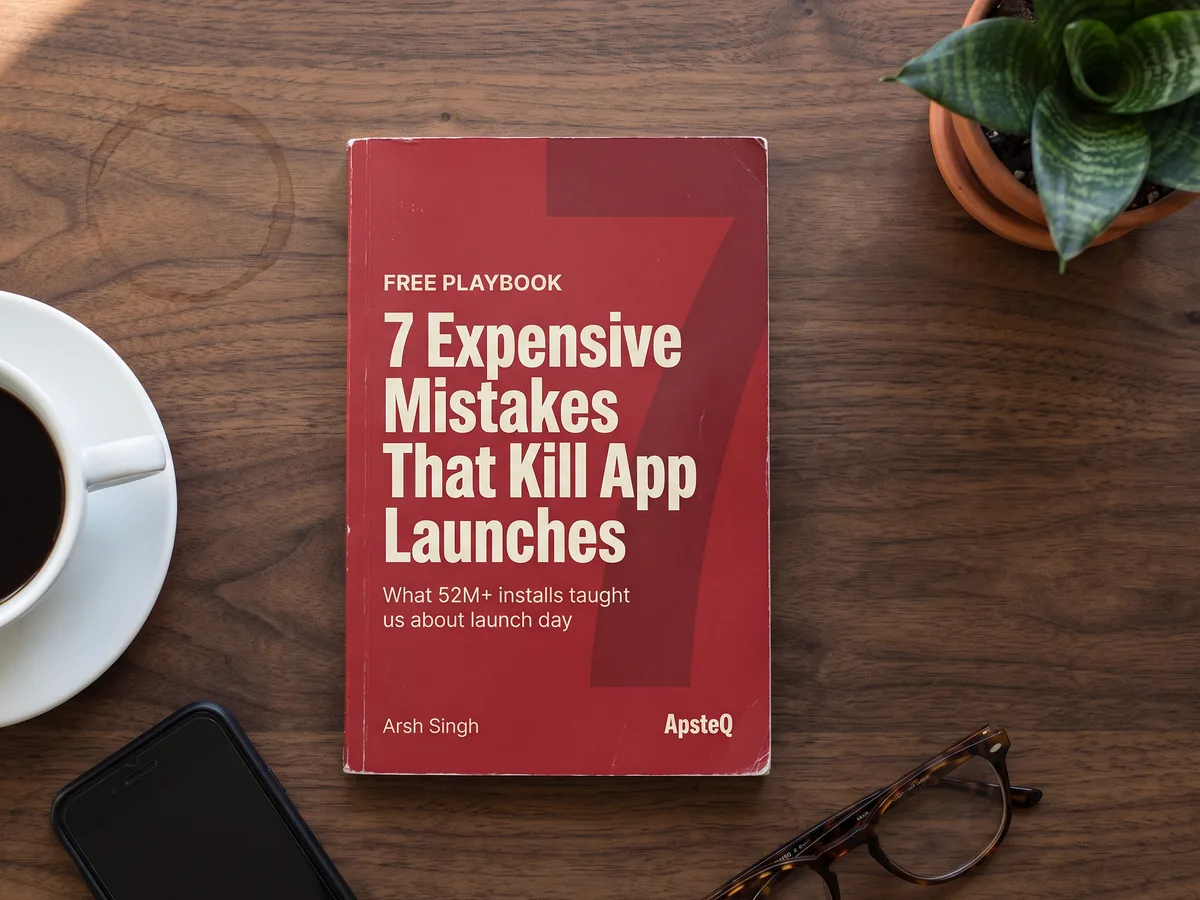
Free download
7 Expensive Mistakes That Kill App Launches
The launch errors we see most often across 300+ app engagements, and what to do instead.
Get the Free Ebook Browse all free guides